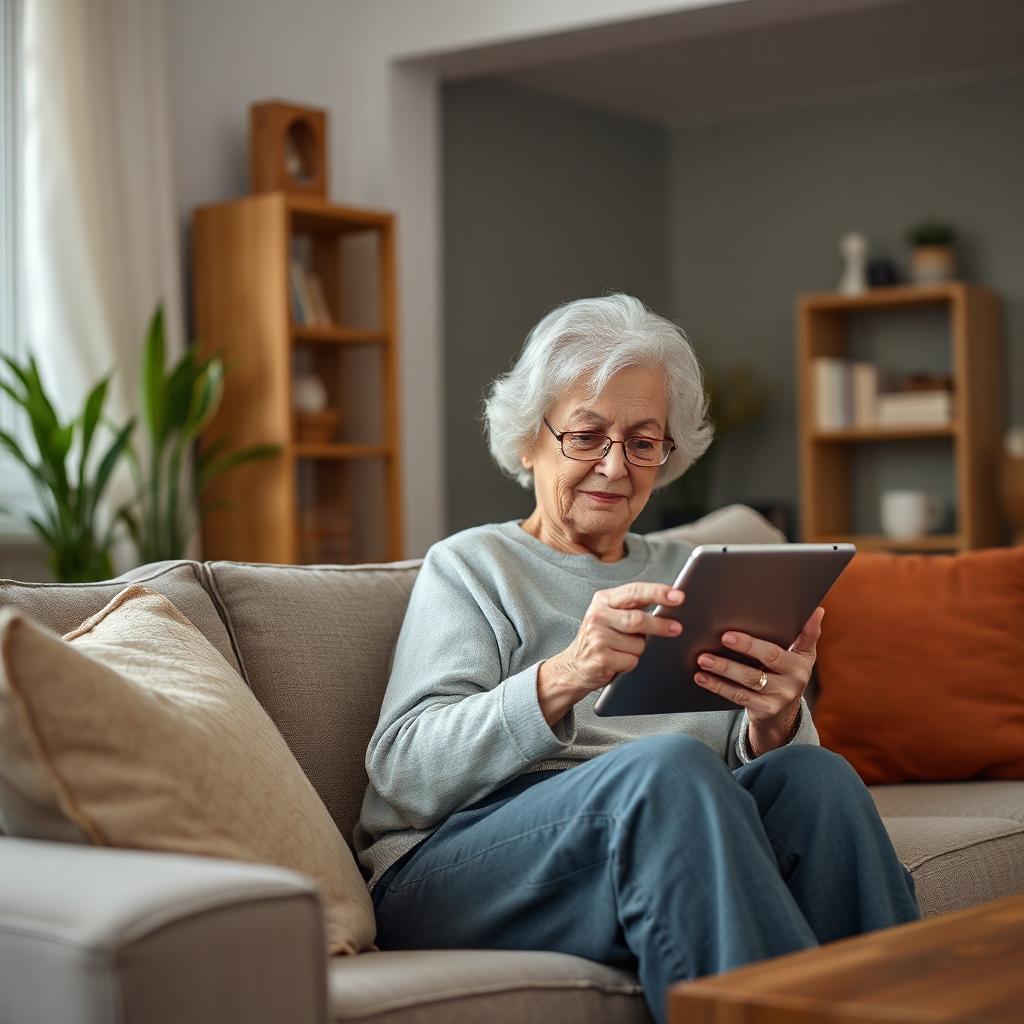
A large majority of older adults hope to age in place. Other seniors prefer the comfort of an independent-living retirement community. Either living situation allows older adults to preserve their independence.
Living independently can become more challenging as we age. Technology increasingly offers useful responses to those challenges. While aversion to technology is a stereotype associated with older adults, the reality is that seniors are a growing market for technological devices. In partnership with AARP, several business startups are focusing on the development of technology that will make easier for seniors to retain their independence as they age.
Smart Home Technology
Smart homes are often equipped with doorbell cameras, thermostats that learn a resident’s patterns and adjust the temperature accordingly, appliances that can be activated and monitored from a cellphone, and digital assistants that — thanks to hidden microphones and speakers — respond to commands from any room in the home. Those devices are useful to people of all ages.
Older adults with limited mobility find extra value in smart home devices that save them the trouble of taking extra steps. Homes that are equipped to lock doors and open or close curtains in response to voice commands increase security while minimizing the need to walk or maneuver a wheelchair.
A 2024 study found that voice-activated digital assistants — such as Apple’s Siri, Google Gemini, and Amazon’s Alexa — improve the functional independence and safety of seniors by enabling them to control their home environment remotely. The researchers discovered an added benefit from digital assistants — reduced reports of loneliness, caused both by an enhanced ability to maintain social connections and by a sense of companionship with the voice-activated assistants.
A relatively new device is highlighted in a Washington Post article about technology that promotes independence as people age. Lotus is a modern refinement of the 1980s Clapper. After installing magnetic light switch covers, a senior wearing a Lotus ring can point her finger at a light switch and, by touching the bottom of the ring, turn lights (or anything connected to the switch) on and off.
Medical Alert Systems
Falls are a leading cause of injury to seniors. Almost all hip fractures are caused by a fall. Taking proactive measures to prevent falls is essential to the maintenance of an older adult’s health and independence.
When precautions do not prevent a fall in the home, seniors may have difficulty reaching a phone to call for help. A medical alert system may be a lifesaver for a senior who has suffered a serious fall in her home.
Medical alert systems include wearable devices that the senior can activate after falling. The devices may take the form of pendants or smartwatches. Simple devices let the user contact emergency services by pressing a button. More sophisticated devices monitor for falls and automatically contact authorities or family members if they detect a fall.
Wearable devices are only useful if a senior wears them. Devices that need to be recharged are also unhelpful if the senior neglects to charge them. As an alternative to wearable devices, medical alert devices that are hardwired or plugged into an outlet can be placed around the home, typically attached to walls or ceilings. They transmit radar or infrared signals to detect the motion associated with a falling body. The devices can be programmed to contact family members, emergency services, or a response center assigned to the device.
Health Monitoring Systems
Some medical alert devices go beyond fall detection. These include wearable devices that continuously monitor vital signs, including heartrate, skin temperature, blood oxygen saturation, and respiration.
Remote patient monitoring systems are used by seniors who need regular medical assessments. Sometimes known as telemonitoring, the systems collect data (such as blood pressure and glucose levels) from a patient at regular intervals, then transmit the data to a health care provider. The doctor can then schedule an appointment, either remotely or in person, when the data suggests a need for medical intervention.
Companionship Technology
While adult children typically focus on safety and health when they think about technology that will help their parents live independently, there are also technological approaches to the problems of loneliness and social isolation. Pets have long been associated with health benefits for seniors, but they aren’t a practical solution to social isolation for all seniors. Robotic pets may be a suitable replacement for a real dog or cat. Robots don’t need to be walked, fed, or bathed, but they can be programmed to respond to — and learn from — interaction with their human owner.
While the ElliQ robot will never be mistaken for a human — it’s about the size of a table lamp — thousands of older adults are benefitting from their interaction with a device that, powered by Artificial Intelligence (AI), behaves very much like a friend. The New York Times documents a positive outcome with a senior who lowered her heart rate and improved her short-term memory after living a year with ElliQ.
Chatbots and digital companions, typically assisted by AI, can also supply social connections that emulate human friendships. While they fill an emotional void, they are most effective at reducing loneliness when used in moderation. Too much time with a digital friend creates the risk of increasing loneliness as users realize that their reliance on AI has displaced human connections.
Fortunately, technology provides opportunities for seniors to connect to family members, friends, and other humans. A smartphone with a contacts list that includes people who are close to a senior can assure that companionship is only a phone call away. Senior-friendly tablets make it easy to place and receive video calls from members of the senior’s social network.
While they can be a bit more complicated, applications like Zoom make it possible for seniors with a computer to attend virtual family meetings. Simpler apps, like WhatsApp and FaceTime, also help older adults stay connected to their loved ones.